High security · Henry Farm
Safe Installation & Servicing in Henry Farm
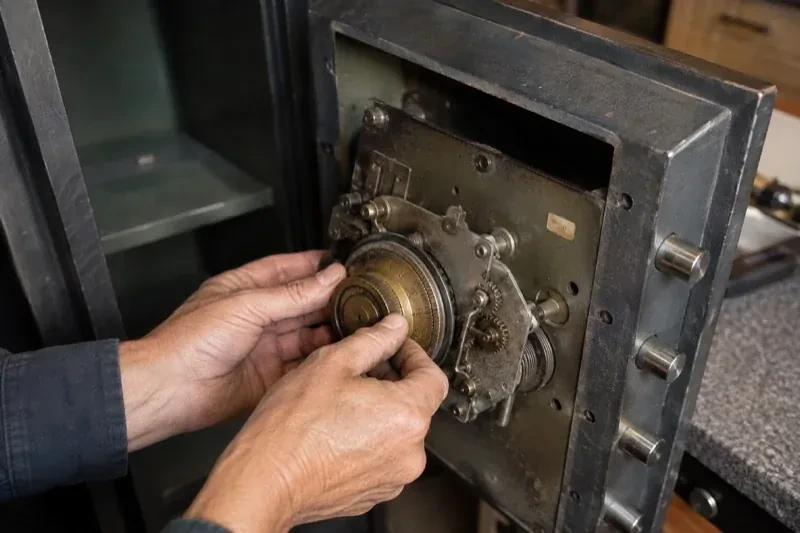
A homeowner inherited a heavy old dial safe from a parent's house, moved it into the new place, and has no idea whether the bolt-work still works, whether the lock is sound, or how it should be anchored.
In plain words
Businesses call for this service for two different reasons that sometimes overlap: protecting cash held overnight, and protecting paper records that would be enormously slow to recreate. The two priorities point toward different construction, since a cash-rated body resists tools while a document-rated interior resists heat and holds its temperature down through a timed fire test. Servicing an existing unit follows the same split: bolt-work and lock mechanics get physical attention, while any fire-rated lining is checked for the trapped moisture that builds up behind an airtight seal.
How the visit goesThe accountant's office keeps a decade of client files in cardboard boxes because the only safe in the building is a small drawer safe meant for a laptop, nowhere near large enough for binders of paper.
Safe Installation & Servicing
How the visit goes
Whether the fire lining can breathe
A fire-rated interior works by trapping moisture inside its insulation, and that same airtight seal can hold humidity against paper and metal for years at a time. On a servicing visit the locksmith checks for a musty smell, damp interior panels, or documents that feel soft at the edges, all signs that trapped humidity has been building unnoticed. On a new installation, this becomes a conversation about desiccant and how often the door should be opened to let the interior air out, rather than something dealt with only after a problem appears.
Confirming everything before the visit ends
The last stage is deliberately unhurried: the lock is opened and closed a final set of times with the owner present, the bolts are checked by hand for any give, and the door is confirmed to swing freely without catching on the frame or the floor. Any paperwork that identifies the model and its ratings is gathered and handed over, along with spare keys for a mechanical override where one exists. The owner sets the combination or code they will actually use, and nobody else leaves the room knowing it.
Batteries that get changed before they fail
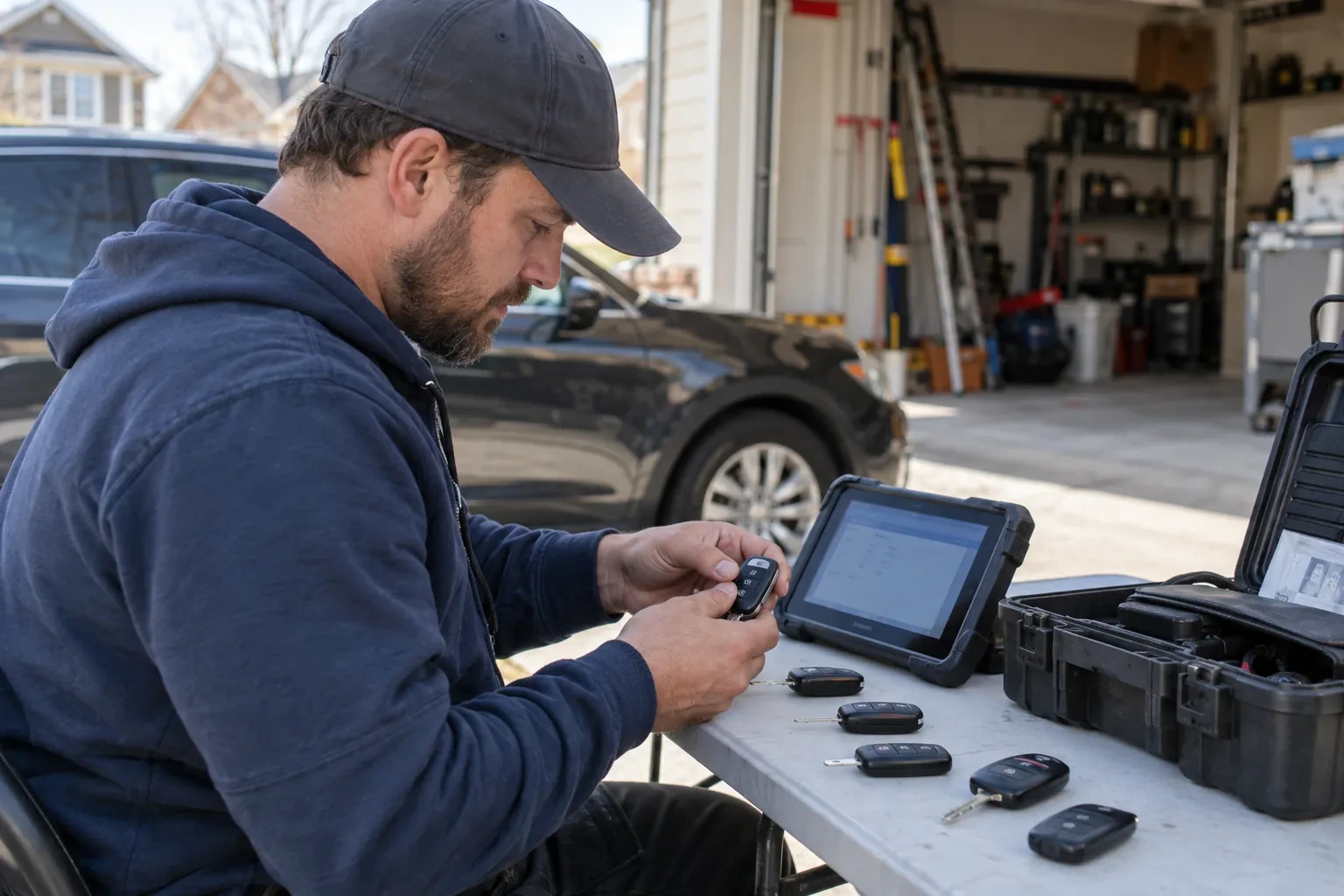
An electronic lock gives some warning before it dies, usually a beep or a flashing light during normal use, and treating that warning as a job to do that same week rather than eventually is what keeps a dead battery from turning into a locked-out morning. Keeping a spare battery of the correct type near the safe, rather than searching for one after the warning starts, closes the loop. The mechanical override key behind the keypad is worth keeping somewhere separate from the safe itself, not taped underneath it.
Safe Installation & Servicing
In the van
Nine-volt backup battery
Mechanical or electronic lock
Mounting plate
Desiccant packets
Wood subfloor lag bolts and washers
Safe Installation & Servicing
What affects the quote
Lock type and number of users
A mechanical dial lock with one combination is a simpler setup than an electronic keypad supporting several separate user codes for different staff members or household members.
Access route to the final position
Stairs, narrow doorways, tight corners, and whether an elevator or loading dock is involved all affect how the safe gets to its spot and how much handling that route requires.
What the safe will store
Cash, jewelry, firearms, paper records, and digital backups each call for different priorities between burglary resistance and fire resistance, and that decision shapes which unit is recommended before anything else is considered.
What to have ready
- Has the safe ever been anchored to the floor or wall before?
- Do you currently know the combination or code?
- Roughly how much does the safe weigh, if known?
Safe Installation & Servicing: questions
QuestionsIs a fireproof safe also resistant to a break-in?
Not automatically. Fire resistance comes from an insulated, sealed construction that is not necessarily built to resist tools, while burglary resistance comes from thick steel and hardened plate that is not necessarily built to survive a sustained fire. Some units are built and rated to both standards at once, but a fire-only safe left unrated for burglary should not be assumed to hold up against a determined attempt with tools.
What kind of floor can a safe be anchored to?
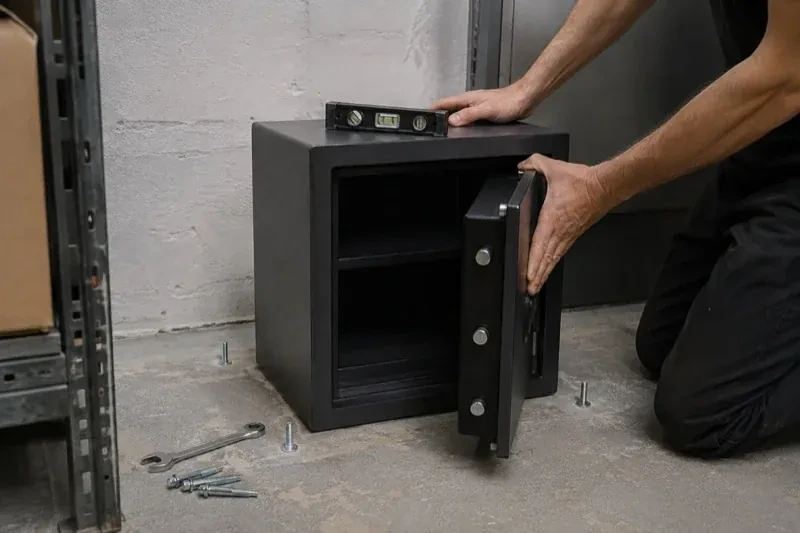
Solid concrete is the most straightforward surface, taking a masonry anchor bolt directly. A wood subfloor works too, provided the anchoring reaches into the floor joists beneath the surface layer rather than just the plywood or the flooring on top. Tile is the awkward case, since a bolt through it tends to crack the surrounding tiles, and an alternative anchoring point or a different spot in the room is usually the better route there.
Can the combination or code be changed after installation?
Yes, on both mechanical and electronic locks. A mechanical dial is reset to a new combination by working inside the lock body, while an electronic keypad is simply reprogrammed at the keypad or through its service menu. Changing it after a change in staff, a move, or simply out of caution is routine work rather than anything unusual, and it can be arranged as its own visit.